In English · networkedthought · 7 April 2026 · excerpts · ~1,600 words
The anchor strategy
Facts are the speed multiplier for deep thinking.
Excerpts from «Petrarca: An Intelligent Companion for the Self-Taught Reader», first published on Networked Thought 7 April 2026. The passages about the method; the app is left out.
I grew up in Norway, where history education is a jumble of disconnected topics. Vikings one week, the Bronze Age the next, the French Revolution the third. By the time you finish school, you've heard all the names — Charlemagne, Constantinople, the Silk Road — but nothing connects to anything.
For most of my life, this didn't bother me much. Then I went to Crete.
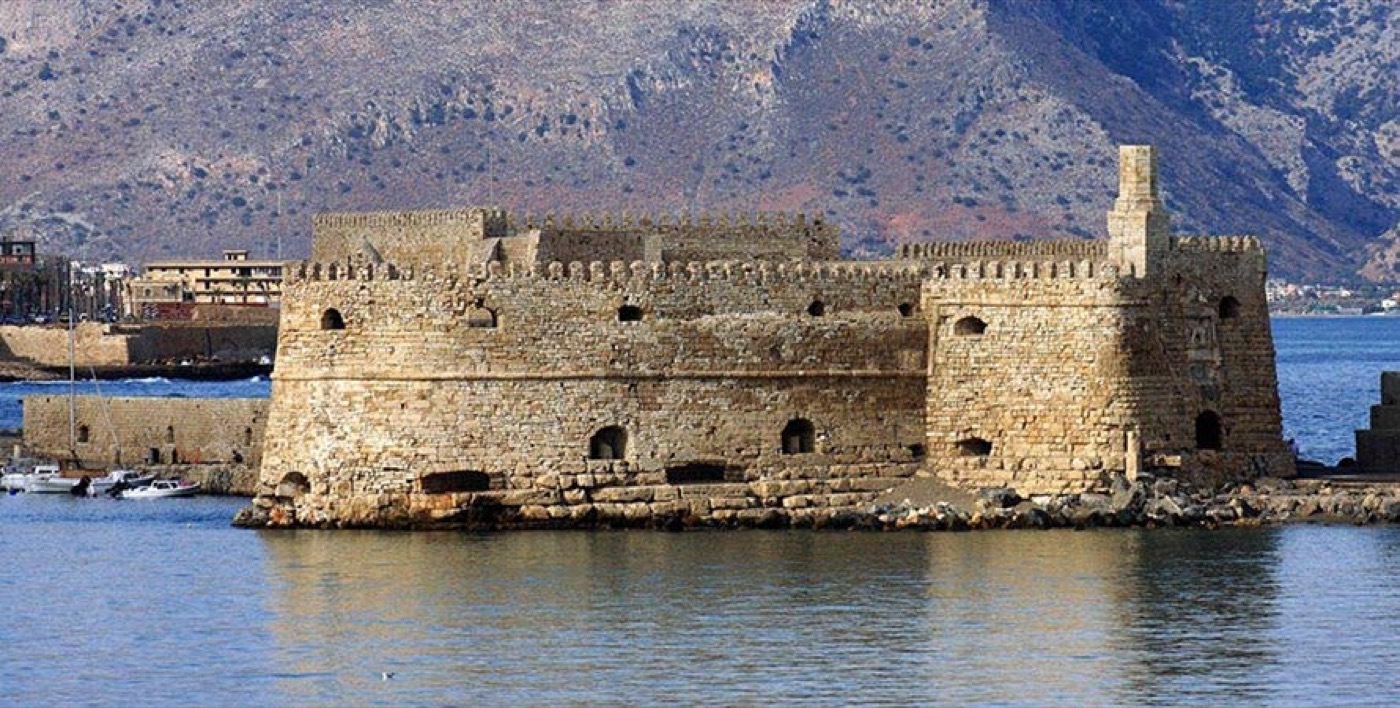
Walking around Heraklion, we came across a massive fortress — walls several meters thick. A poster explained it had been besieged by the Ottomans for thirty years while held by the Venetians. I had lived in Italy, visited Venice many times, but never knew Venice had colonies. Then: "Before the Venetians, it was part of the Byzantine Empire." I just stood there. I could not tell you a single meaningful thing about the Byzantine Empire. Constantinople — does that have something to do with Rome? At what time? I was 42 years old.
I had read the big history books — Sapiens, Guns Germs and Steel — and they felt fascinating in the moment. But I retained almost nothing. Worse: I couldn't tell what was controversial. When everything is new, you can't see the choices the author is making. You don't have the background knowledge to think critically.
History is different from other kinds of reading. In a philosophy book, there are key ideas to extract. In a history book, every sentence contains new information — names, dates, places, causes. You feel cognitively overloaded, stressed because you feel like you should be remembering everything, and three months later it's all mush.
I was almost giving up on reading nonfiction. The gap between what I understood while reading and what I could reconstruct months later felt demoralizing.
The Anchor Strategy
Think of the Civilization game: the map is foggy except for the small area you've explored. You pick a spot and go deep — not a quick Wikipedia skim but multiple sources, historical fiction, documentaries, maps. You try to understand the people, the architecture, the living conditions. And from that patch of dry land, you expand to adjacent territory.
I described this in a short video using Charlemagne as my anchor. I started around 800 AD — the coronation as the new emperor of the Western Roman Empire. I ended up reading three historical novels in German, richly researched, covering the chronology but also the role of the church, the Germanic tribes, the pagan faiths. Then I could expand in every direction:
West to Spain — overrun by the Muslims, Charlemagne's failed expedition to Barcelona, the encounter with the Basques that became the Song of Roland.
East to Constantinople — Charlemagne's complex relationship with Empress Irene, the worry that his coronation would be seen as claiming the whole Roman Empire, the possible marriage between Charlemagne’s daughter and Irene’s son.
Further east to Baghdad — the Caliph who sent Charlemagne a white elephant that made it all the way to Germany and became a battle elephant (they found its bones in a river).
South to Italy, the Pope, the Langobards.
North to the Vikings — Alcuin, the great scholar at Charlemagne's court, came from Northumbria and wrote about the attack on Lindisfarne.
Backward in time: the fall of the Western Roman Empire, the migrating peoples. How did the Carolingians take power. How did the Pope end up having to beg Charlemagne for support, and crown him Emperor as thanks?
Forward in time: the split into Germany and France, the beginning of the Viking Age.
The same could be said about Caesar, Alexander, the Persian Wars. Each anchor opens adjacent territory. The knowledge grows outward like the explored area on a game map.
But Hooks Need a Skeleton
The anchors give you gist — deep, vivid, connected understanding. This is the most durable kind of historical knowledge. But specific facts matter too. Dates, names, sequences are the skeleton that everything hangs on.
An example. I picked up a Norwegian high school textbook on the French Revolution. It said people resented the church's taxes. And I thought: only a hundred years earlier, France had a devastating civil war over the conflict between Protestants and Catholics. Tens of thousands killed. Not mentioned by word in that chapter. Does it matter? I don't know. But I couldn't have asked that question without knowing about the Wars of Religion. The factual scaffold made the critical question possible. What happened before what, what happened at the same time in other places?
Sam Wineburg did a study of two historians reading the same Lincoln documents. The specialist — who knew the sequence of days within specific months — defined the interpretive issues in four minutes. The non-specialist spent forty minutes "cognitively flailing" before reaching a narrower interpretation. Same intelligence, same skills. The difference was the facts. Facts are the speed multiplier for deep thinking.
Michael Nielsen makes the same point from a different direction. Drawing on chess research: experts don't think differently, they chunk differently. A master recognizes 25,000–100,000 patterns as single units — expanded working memory. "Having more chunks memorized in some domain is somewhat like an effective boost to a person's IQ in that domain." If "the Punic Wars" is a rich chunk rather than an unfamiliar term, you can hold more of the argument in your head.
E.D. Hirsch extends this into a full theory of literacy: reading comprehension depends on specific background knowledge, not transferable reading skills. A striking study by Recht and Leslie gave students a passage about baseball: poor readers who knew baseball outperformed strong readers who didn't. Domain knowledge trumped reading ability.
This connects to cognitive load theory. Working memory holds roughly 7±2 items. But "items" can be large, richly-encoded chunks or small, disconnected fragments. Prior knowledge reduces cognitive load by letting you process larger units. When "the Investiture Controversy" is a rich chunk, I can hold the whole argument in working memory. Without it, each unfamiliar name consumes a slot and the argument overflows.
So hooks and facts form a virtuous cycle. Deep anchors give you gist. The factual scaffold gives you the skeleton. Each supports the other.
The Temporal Hook Hierarchy. From building Hamarquizen and my own experience, I've found four types of temporal connection, roughly ordered by how well they stick: (1) Anchoring to events I already know ("Archimedes died ~75 years after Alexander"). (2) Same-moment connections ("While Archimedes defended Syracuse, Hannibal was in Italy"). (3) Causal chains ("Archimedes' death was a consequence of Hannibal's invasion"). (4) Cross-domain surprises — but only if I already know the other domain. A connection to something unfamiliar isn't a hook, it's noise.
Deep Reading, Light Touch
I don't want an iPad app for reading PDFs with highlighting tools. During my PhD, I built elaborate pipelines — downloading papers, highlighting, extracting highlights, processing them. That worked as a full-time student. It doesn't work for an adult with a family.
I barely open my laptop outside work. I try not to look at my phone much when I'm home with my family. I treasure the hours of deep reading — by the fireplace early on a Saturday morning, or half an hour in bed. Those are sacred. The system should never make me feel like I should be annotating.
Memory and Understanding
The idea is simple: review information at expanding intervals — 1 day, 3 days, a week, a month. Each successful recall lengthens the interval. It started with physical flashcards and Leitner boxes in the 1970s, then went digital with SuperMemo and Anki. Medical students use it to memorize anatomy; language learners use it for vocabulary. It works spectacularly for discrete facts.
Michael Nielsen’s essay about how he used spaced repetition to quickly enter a new academic field, and the importance of memory and factual recall for understanding complex texts was an eye-opener for me, and extremely inspiring. With Andy Matuschak, he designed Quantum Country and Andy continued with the Orbit project, embedding review prompts directly into prose, integrating both stages.
If you accept the premise that spaced repetition can help you understand complex topics, there are two tensions: writing good SRS cards is difficult, and takes a lot of time. But using other people’s cards is not helpful, because of the gap between initial learning/encoding, and repetition. Seeing an unknown fact as an SRS review card with no context is not a good way to learn, and only becomes frustrating.
The brilliant insight was to embed spaced repetition cards in a textbook. You learn a concept through carefully sequenced text, examples, pedagogical examples, narrative and context. You immediately test your understanding, but the card uses to test your understanding then moves to a spaced repetition system, ensuring that you never forget what you learnt.
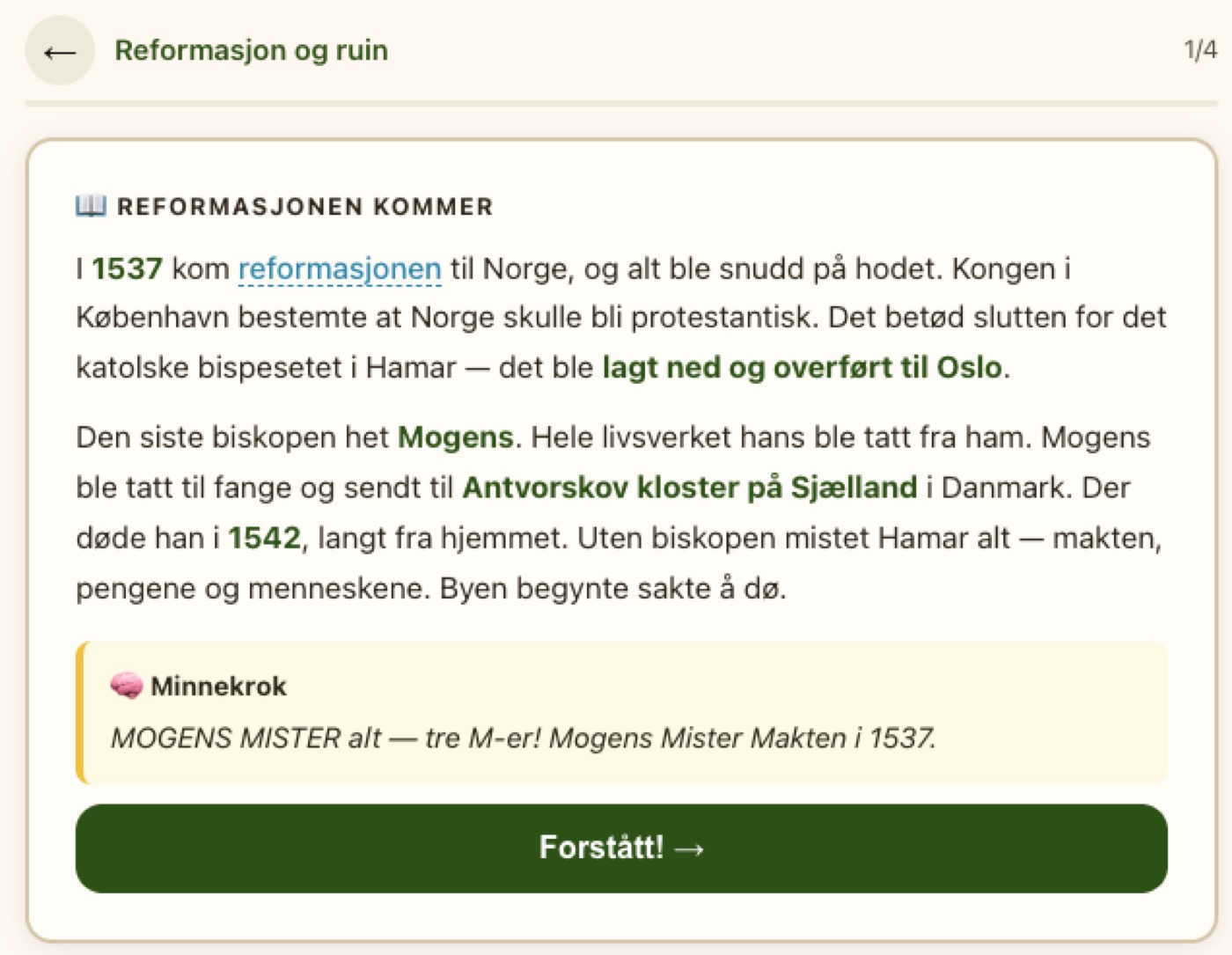
My son was participating in a local quiz competition about local facts, and had to memorize a lot of names and dates, difficult for an 11-year old. Inspired by Orbit, I created a curriculum of the 20 most important people and events, wrote micro-stories for each, and integrated quizzes that fed into a scheduling bucket — the PRIME → READ → TEST flow. Rich memory hooks tied facts together: Hanna Winsnes was born in 1789, the same year as the French Revolution. It worked — he learned a huge amount of facts in a few days and found it fun.